
Home/Buyer's Guide/Choosing a CNC Machining Supplier in Shenzhen: Precision Parts and Titanium
Send one drawing to a dozen shops in Shenzhen and quotes come back from USD 11 to 36. The gap is not greed — it is a different process route, a different machine class and a different inspection standard. This guide turns incomparable prices back into comparable process plans.

Finding a CNC machining supplier in Shenzhen is easy. Choosing one is not. Bao'an, Longhua, Longgang and neighbouring Chang'an will produce a dozen candidates inside a few kilometres. Send one drawing and quotes come back from USD 11 to 36, lead times from 7 to 25 days — and every shop claims high precision and one-stop service.
This is not a ranking. It is a set of tests: how the Shenzhen supply chain is tiered, what a precision parts shop should be able to prove on the spot, what actually determines the accuracy of CNC precision machining, and why titanium machining costs more and runs slower. It ends with a six-step selection order you can follow directly.
1. The Shenzhen supply chain: tiers first, headcount later
Shenzhen CNC machining shops fall into three tiers, and the price gap starts here — not with how new the machines are.
| Tier | Typical size | Price level | Suits | Main risk |
|---|---|---|---|---|
| Trading house / broker | 1–3 people, no machines, everything subcontracted | Mid to high (+15–30%) | Mixed low volumes, urgent jobs, single point of contact | Nobody owns the process decision; blame travels up and down the chain |
| Single-process job shop | 3–10 machines, milling or turning only | Lowest | One operation, standard tolerance, clean drawing | Grinding, finishing and inspection are outsourced — the tolerance chain leaves the building |
| Full-process shop | 20+ machines, turning, milling, grinding, inspection, assembly | Middle | Precision parts, repeat batches, FAI reports and traceability | Not the cheapest; small orders may queue behind larger ones |
The real advantage of Shenzhen is not cheap machines — it is process density. Plating, anodising, heat treatment, laser marking and precision grinding are usually same-day to book and back within two or three days. Move the same part inland and each leg adds three to five days of freight. On a fifteen-day precision part, that freight is a fifth of the schedule.
There is also geography. Bao'an and Fuyong lean towards 3C and connectors, Longhua Dalan towards prototypes and small-to-mid precision batches, Longgang and Chang'an towards tooling and larger structures. The same drawing quoted in different districts follows a different logic — so confirm you are comparing the same kind of work before comparing numbers.
2. Precision parts capability: three lists, not a brochure
To judge a precision parts supplier, stop counting machines and ask for three lists.
2.1 The machine list: five parameters beat a headcount
| Parameter | Why it matters | Typical trap |
|---|---|---|
| Travel and table load | Whether the part fits — and whether it sags once it does | Travel quoted without load; large parts deflect on the table |
| Max spindle speed and torque | Small tools need speed; heavy stock removal needs torque | Speed quoted alone; low torque chips the edge when roughing titanium |
| Tool magazine capacity | How many features one setup can cover | Too few pockets means mid-cycle tool changes, i.e. a second setup |
| Table type (3+2 or simultaneous) | Whether angled features and deep pockets finish in one go | "5-axis" that is really indexing |
| Positioning / repeatability | Repeatability drives batch consistency | Positioning quoted, repeatability omitted |
"We have twenty machining centres" carries no information. Twenty 3-axis machines with a programmer who only edits post-processors will underperform five machines with someone who understands the process.
2.2 The process list: outsourcing ratio sets lead time and accountability
Turning, milling, grinding, wire EDM, sinker EDM, heat treatment, surface finishing — which of these are in-house? A shop that outsources grinding and finishing does not hold its own tolerance chain or schedule, and problems get passed back and forth.
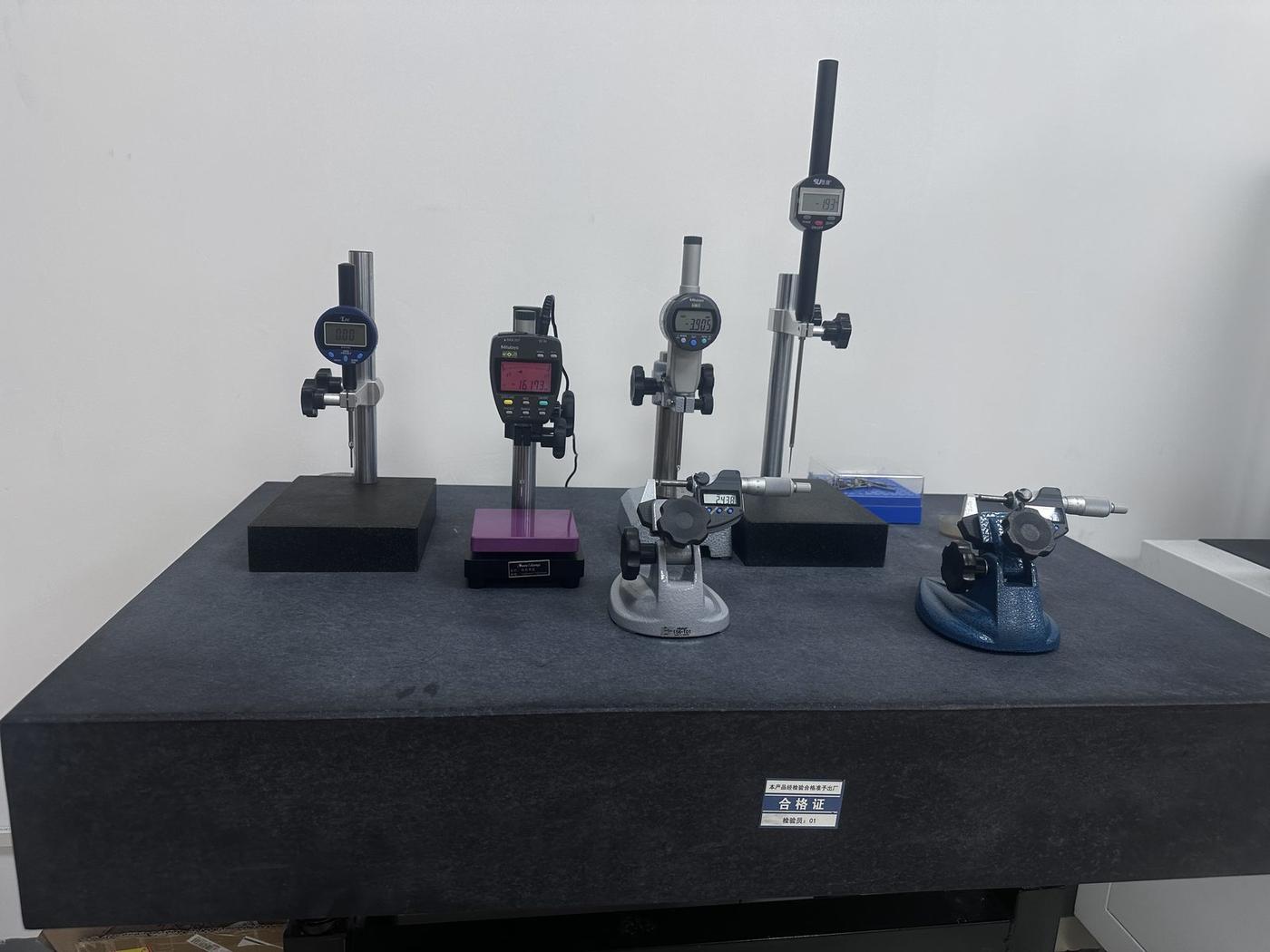
2.3 The inspection list: the machine and the instrument must speak the same language
CMM, 2.5D vision, profile projector, roughness tester, hardness tester. The question is not whether they exist, but whether they match your tolerance. A ±0.005 mm callout checked with a calliper is a report you can skip.
3. Accuracy control in CNC precision machining
Accuracy in CNC precision machining is not a number — it is a sentence: under which conditions, verified by which method, held to what level in production. So the question "what is your accuracy" deserves a counter-question: which material, what size, which feature?
| Band | Typical tolerance | Size range | How it is held | Price effect |
|---|---|---|---|---|
| Standard | ±0.05 mm | Any size | 3- or 4-axis plus calliper / micrometer | Baseline |
| Precision | ±0.01 mm | ≤300 mm | Fine milling or grinding, sampled on a CMM | +20–40% |
| High precision | ±0.005 mm or tighter | ≤150 mm, climate-controlled | Multi-setup correction / grinding / in-machine probing, 100% inspection | +50–100% |
3.1 Five lines of a first article report
Datum definition, inspection equipment used, measured values on critical dimensions, material lot, finishing record. Five lines means a process exists. A report that only concludes "conforms" usually means parts were selected rather than controlled.
3.2 Process capability beats pass rate
Take thirty parts and calculate Cpk. Above 1.33 the process itself is stable. A 100% pass rate with no distribution data usually means sorting, not control — and it collapses the moment volume rises.
3.3 Distortion is the real cost driver
On thin walls, slender shafts and deep pockets, tolerance is rarely lost at the spindle. It is lost when the part springs back after the clamps release. The fixes are stress relief, symmetrical material removal, soft jaws, vacuum or wax fixturing — and finishing in one setup wherever possible.
4. Titanium machining: where the cost comes from
Titanium precision machining typically quotes at two to four times the aluminium price, with a slower cycle. That is the material, not a markup.
| Property | Ti-6Al-4V | 6061 aluminium | Consequence |
|---|---|---|---|
| Thermal conductivity | ~7 W/(m·K) | ~167 W/(m·K) | Heat stays at the cutting edge; tool life drops sharply |
| Elastic modulus | ~110 GPa | ~69 GPa | Deflection and chatter; thin walls drift out of tolerance |
| Chemical reactivity | Reacts with tool material when hot | Low | Built-up edge, poor surface finish |
| Work hardening | Pronounced | None | Hardened skin makes the second pass harder than the first |
4.1 Three properties decide the process, not "a few more passes"
Poor conductivity means high-pressure through-coolant, low speed with heavy feed and a sharp edge — slower is safer than letting heat sit in the tool. Low stiffness means short tool overhang, rigid fixturing and light radial engagement: kill the chatter before chasing speed. High reactivity means uncoated carbide or AlTiN, no chlorine-bearing coolant, and separate collection of fine chips, which are a fire risk.
4.2 Where it is used
Airframe brackets and fittings, medical bone screws and surgical instruments, semiconductor vacuum chamber flanges, UAV and robot joints, optical communication housings, marine corrosion-resistant parts. They share three traits: low volume, high unit value, expensive failure — which is why the process plan matters more than the unit price.
4.3 Three things to send with an RFQ
Grade and condition (Ti-6Al-4V annealed or solution-treated and aged), stock form (bar, plate, forging), critical tolerances and surface requirements. Miss one and the quote can differ by 30% — and the numbers stop being comparable.
5. A six-step selection order
1. Fix the process route before comparing price. Only identical routes — same number of axes, same number of setups, same finishing — are comparable. Otherwise the lowest quote is simply the shortest route.
2. Prototype a real part. Standard test coupons do not reveal thin-wall distortion or chip evacuation in deep pockets.
3. Ask for an itemised quote. Material, machining time, fixturing, finishing, inspection. A shop that can break it down knows where the money goes.
4. Agree acceptance criteria and non-conformance handling. Which standard, which AQL, who pays for rework — these three affect total cost more than payment terms.
5. Do not load the first order. Run 30% first. Ramping beats squeezing the unit price.
6. Notice whether they ask questions. Shops that probe your datums, material condition and assembly relationships usually perform. "Yes, we can do it, send the drawing" is a warning sign.
We get audited against these same standards regularly. For the equipment and process envelope, see capabilities, the 5-axis and mill-turn sections; for part families, see products.
6. Common questions
Why can quotes for the same part differ by two or three times?
Four things: process coverage (whether grinding and finishing are included), machine class and accuracy envelope, batch size and scheduling priority, and whether CMM inspection is in the price. Align the process route and acceptance criteria first — otherwise the cheapest quote is simply the shortest route.
Can every part be machined to ±0.005 mm?
No. That band usually applies to small and medium parts, in a climate-controlled shop, on features that can be finished in one setup or ground. Deep pockets, thin walls and large parts need feature-by-feature assessment — sometimes the machine is capable and the part still moves once the clamps come off.
Why does titanium take so much longer than aluminium?
Cutting speed is one fifth to one eighth of aluminium, tools wear fast and need frequent changes, and stress relief, extra operations and denser inspection all add time. A titanium part of similar complexity typically takes 1.8 to 2.5 times the hours of the aluminium version.
Is a 10–50 piece order worth placing in Shenzhen?
Yes, if you pick a full-process shop that explicitly accepts small batches. Shenzhen's advantage is process density and prototyping speed. On small batches the real cost sits in programming and fixturing, not material — so do not judge price by the material line alone.
Send a drawing, get an itemised quote
From one piece. Quotes within 24 hours, itemised into material, machining, fixturing, finishing and inspection. Even if we do not end up working together, it works as a benchmark.
Request a Quotation
Share your requirements — formal quotation within 24 hours. Your information is used for quoting only and kept strictly confidential.
Have drawings? Get an itemized quote within 24 hours
A 2D drawing + 3D model (STEP / IGES) + quantity tiers are enough. Material, machine hours, programming & fixtures, outsourcing and inspection listed separately, plus a free DFM sheet. No drawing review calls.
Send drawings for a quote