
Five axes is not simply a more expensive machine — it compresses three to five setups into one. Fewer setups means less cumulative error, less indicating time and less risk of clamp marks. That is the real test for whether a part belongs on a 5-axis machine.
First, separate two different things: 3+2 indexing and simultaneous 5-axis
The industry calls any machine with two rotary axes a "5-axis machine", but there are two quite different ways to use it, with very different cost and capability.
3+2 indexing: the A/C (or B/C) table rotates the workpiece to an angle and locks, then cuts in three-axis mode. It solves the problem of repeated setups on multi-face parts. Programming stays planar, rigidity is high and cost is low — for most structural parts this is the best option.
Simultaneous 5-axis (RTCP): all five axes interpolate during the cut while the tool tip follows the programmed path. It solves continuously varying freeform surfaces — impellers, helical faces, curved flow channels. Without RTCP, a simultaneous path is almost impossible to write in machine coordinates, and the workarounds through post-processing are not accuracy-controlled.
The test is one sentence: does the part have a continuously varying surface? If yes, it needs simultaneous. If no, 3+2 is usually the better buy.
| Item | 3+2 indexing | Simultaneous 5-axis (RTCP) |
|---|---|---|
| Rotary axes | Indexed and locked | Interpolating throughout |
| Programming | Planar logic, standard CAM | Post-processor with RTCP support |
| Suitable features | Planes, holes, prisms, angled faces | Freeform surfaces, channels, impellers |
| Faces per setup | 4–6 faces | Everything except the clamping face |
| Unit cost | Lower | Higher (machine rate roughly 1.4–2×) |
| Classic misuse | Using it for an impeller | Using it for a flat plate |
Equipment and capability — listed by what it can do, not by headcount
Travel, table configuration and tolerance capability decide whether a part can be made at all and whether it is worth making. These are the rows we check before quoting.
| Item | Capability | Notes |
|---|---|---|
| Axes | 3 / 4 / 5-axis (indexed and simultaneous) | Machines are assigned by part feature, not every job goes on 5 axes |
| Table configuration | A/C, B/C | RTCP tool-centre-point following standard on simultaneous machines |
| Max workpiece | Up to 1800×1200×650 mm | Oversized parts assessed case by case with fixturing |
| Achievable tolerance | ±0.005 mm typical | Varies with feature, material and setup rigidity |
| Spindle | High-speed spindle | Aluminium high-speed work and steel heavy cutting are scheduled on different machines |
| Materials | Aluminium / stainless / titanium / copper / brass / PEEK / carbon fibre | Titanium and PEEK need dedicated tooling and parameters |
| Surface finish | Anodising / plating / PVD / bead blasting / polishing | Some processes outsourced; lead time quoted separately |
| Inspection | Mitutoyo CMM, 2.5D vision, micron height gauge, temperature-controlled room | Full first-article plus batch sampling, report shipped with parts |
How accuracy is actually held: lock down each variable
±0.005 mm is achievable, not guaranteed on every part. On the same machine, fixturing, thermal balance and stock allowance can move results by an order of magnitude. We control the variables one by one:
- Fixturing: finish as many features as possible in one setup to avoid datum transfer. Thin-wall parts use vacuum, low-melt alloy or flexible support so clamping force does not crush the part.
- Thermal: roughing and finishing are separated; the machine and workpiece return to thermal balance before finishing. In high-speed aluminium cutting the cutting heat often exceeds machine thermal growth, so cooling and dwell time belong in the process.
- Programming: RTCP post-processing with tool-tip following; critical surfaces keep 0.05–0.1 mm for a single-axis finish pass instead of being forced through machine coordinates.
- Inspection: full CMM first article with CPK ≥ 1.33 on key features; AQL sampling for batches; inspection report ships with the parts.
- Boundaries: deep cavities, thin walls and large parts are assessed feature by feature. The quotation states which dimensions are guaranteed and which follow general tolerance.
Four part families we machine most on 5 axes
These four are where 5-axis pays off most often — and where process difficulty is most often underestimated at the RFQ stage.
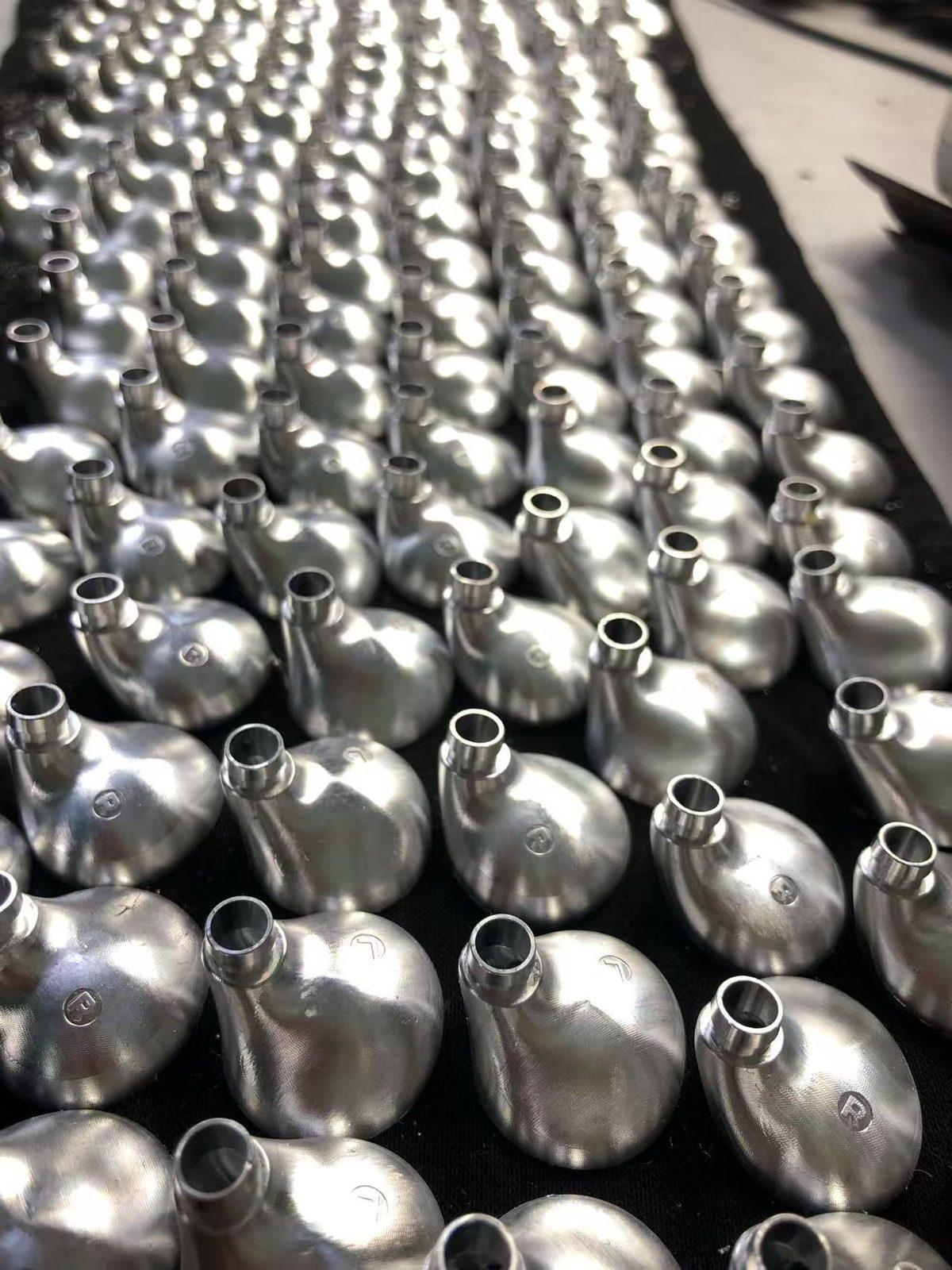
Continuous surfaces (impellers / curved shells)
Curved channels can only be cut simultaneously. The difficulty is tool-axis vector planning and blend-mark control; usually one setup, with CMM section scans of the channel afterwards.
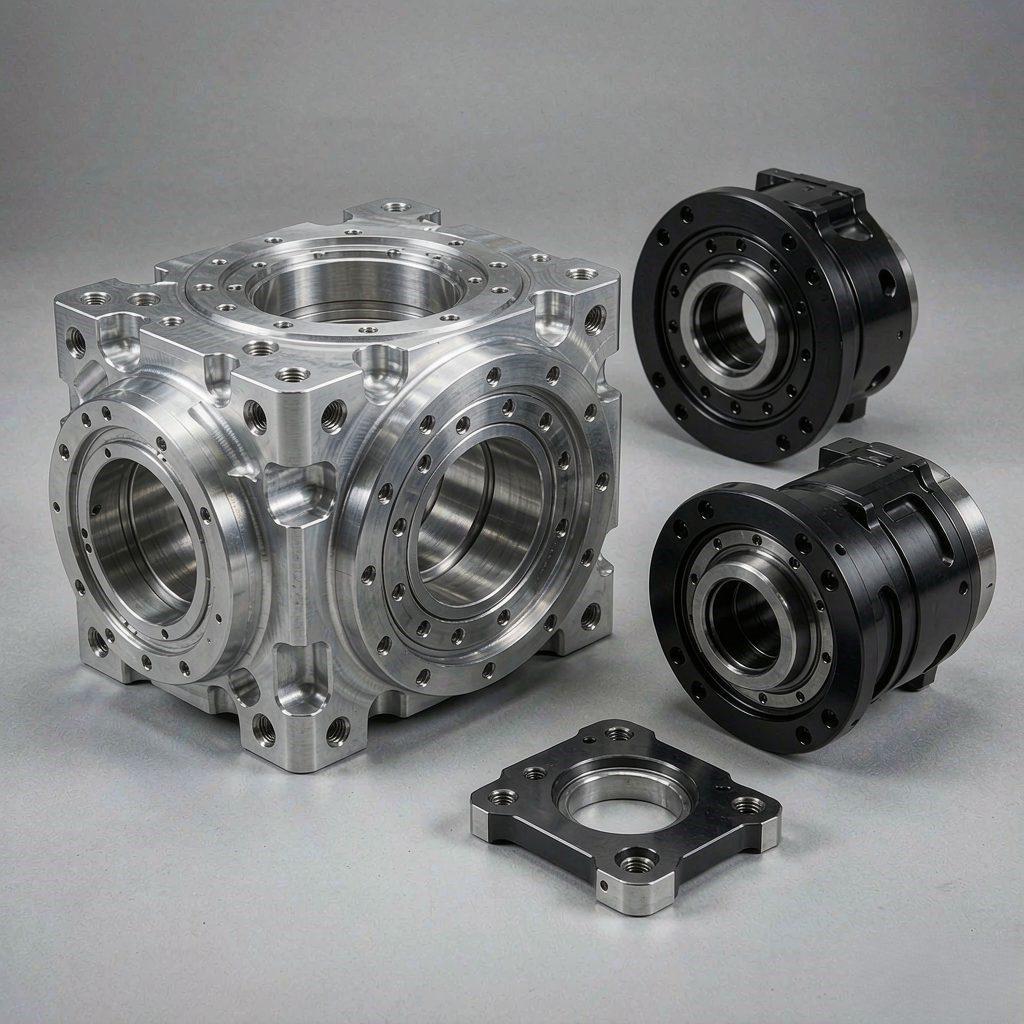
Multi-face bearing bores (joint housings)
Concentricity across two or three bores comes from the setup, not the machine. Boring everything in one setup is far more stable than sequential operations.
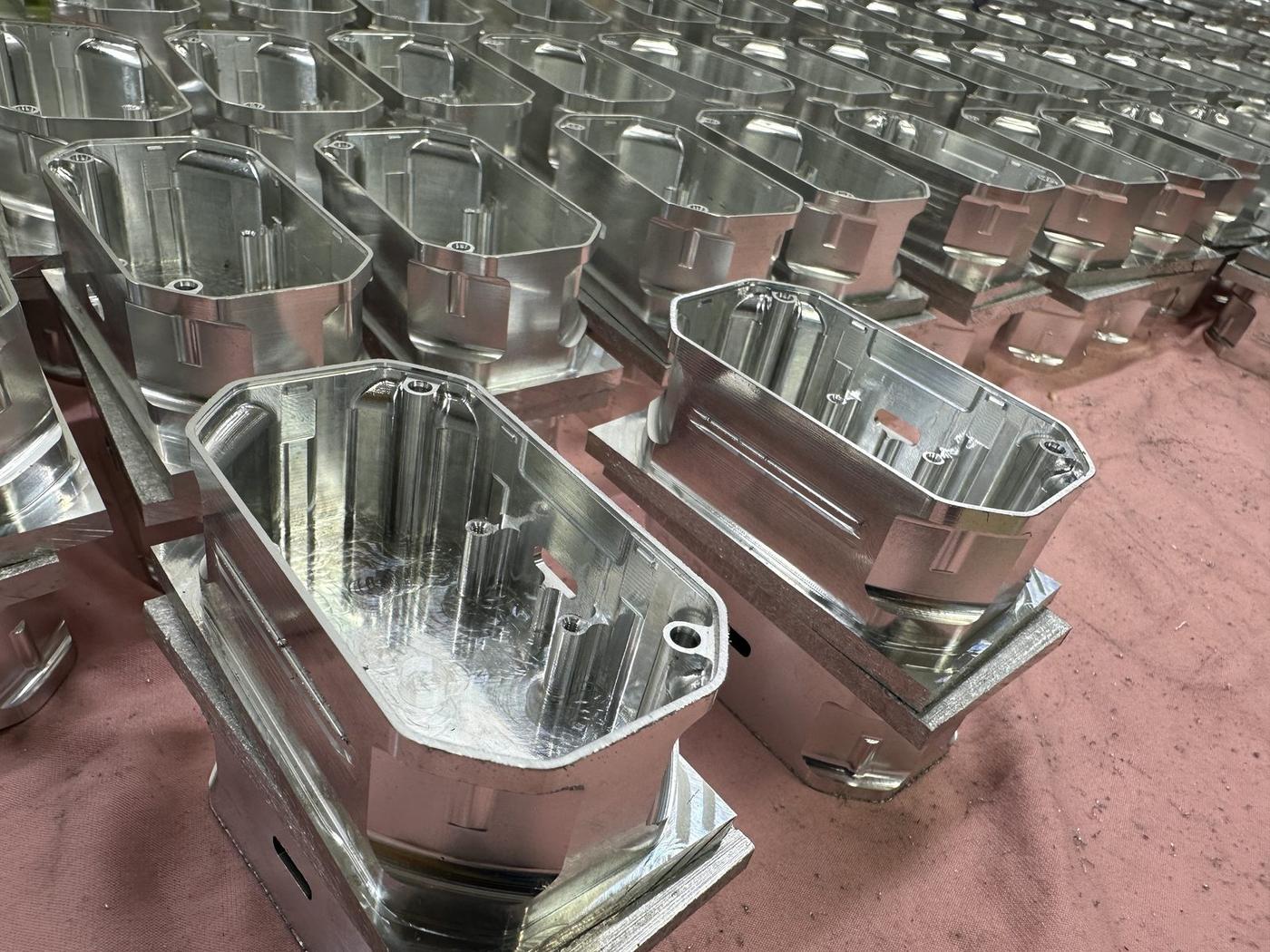
Irregular multi-face structural parts
Features on four or more sides — 3+2 indexing is enough, simultaneous is not required. The key is finishing the datum face inside the same setup.
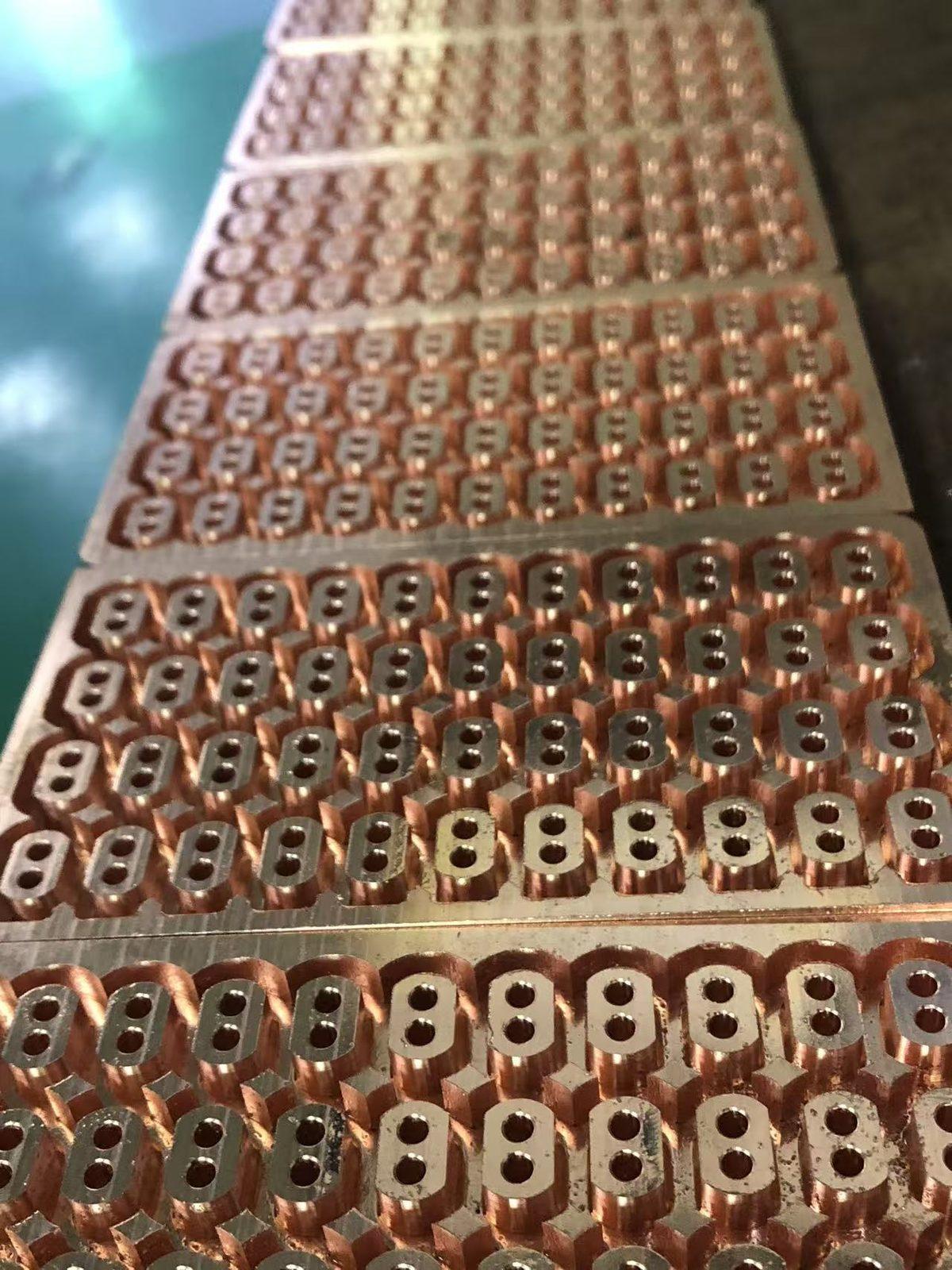
Thin-wall cavities and heat sinks
At 0.5–1.5 mm wall thickness, clamping force distorts the part more than cutting force does. Vacuum fixturing, light cuts and symmetrical material removal are standard practice.
Same part, three routes, two to three times the cost difference
The difference is not the machine — it is the number of setups and the rework rate. Before choosing a route, answer three questions: how many directions carry features, how tight is the critical tolerance, and how large is the batch.
| Route | Setups | Achievable tolerance | Cycle time | Best for | Avoid when |
|---|---|---|---|---|---|
| 3-axis, multiple setups | 3–5 | ±0.02–0.05 mm | Baseline | Single-face parts, simple geometry, large batches | Multi-face features, freeform surfaces |
| 3+2 indexing | 1–2 | ±0.01–0.02 mm | Medium | Prismatic parts, hole patterns, mostly planar | Continuous surfaces |
| Simultaneous 5-axis | 1 | ±0.005–0.01 mm | High | Impellers, channels, freeform, thin walls | Simple parts, very large batches |
Route selector: three inputs, one recommendation
Pick feature direction, critical tolerance and batch size to get a recommended route and a relative cost index. The index is normalised to 3-axis single-setup = 100; it compares routes only and is not a quotation.
The model estimates setups × machine rate. Material, surface finishing and freight are excluded. A real quotation follows drawings and quantity.
Send all six items with the RFQ
Eight out of ten quote revisions come from missing information, not from the machine. With all six, an itemised quote (material / machine time / programming and fixturing / subcontract / inspection) is ready within 24 hours.
| Item | Why it is required | What happens without it |
|---|---|---|
| STEP / IGES 3D model | Basis for surfaces and toolpaths | 2D only — freeform parts cannot be assessed |
| 2D drawing + critical tolerances | Decides route and inspection plan | Vague tolerances guarantee a re-quote |
| Material grade and temper | 6061 vs 7075 and 304 vs 17-4PH differ twofold in machinability | Unknown material, unreliable cycle time |
| Quantity and annual demand | Decides whether dedicated tooling makes sense | Quoted at 1 pc, actual 5000 pcs — inflated unit price |
| Critical and cosmetic faces | Decides fixturing and downstream operations | Unmarked cosmetic face, sample rejected |
| Finishing and required date | Subcontract operations drive total lead time | Machining only — delivery slips by 1–2 weeks |
When you should not use 5 axes
More axes is not automatically better. In the cases below we recommend 3-axis or 3+2, which is cheaper than forcing the part onto a 5-axis machine:
- Single-face plates and panels: one 3-axis setup is enough; 5 axes only adds machine hours.
- Very large batches of simple parts: dedicated fixturing plus multi-station 3-axis clearly lowers unit cost.
- Non-mating surfaces with tolerance above ±0.1 mm: 5-axis accuracy is wasted; spend it on tool holders and fixturing instead.
- One or two pieces with no freeform surfaces: 3+2 is sufficient and avoids simultaneous programming cost.
Frequently asked questions
Is 5-axis machining always more expensive than 3-axis?
The unit rate is always higher; the total cost is not always. Going from four setups to one removes three indicating operations, three clamp-mark risks and cross-operation waiting. On complex parts the total is often lower — on simple parts it is not.
3+2 indexing or simultaneous 5-axis?
Look for continuously varying surfaces. A prismatic part without freeform is better on 3+2: higher rigidity, simpler programming, 30–50% cheaper. Impellers, channels and helical forms need simultaneous.
Can you guarantee ±0.005 mm?
It is achievable, not unconditional. Typical small and medium steel or aluminium parts reach it with thermal control, one setup and full CMM inspection. Deep cavities, thin walls and large parts are assessed by feature, and the quotation states which dimensions are guaranteed.
What is the minimum order quantity?
One piece. At the prototype stage the reason to use 5 axes is fewer setups and faster samples, not lower cost; tooling and unit price are discussed at volume stage.
What do you need for a quotation?
STEP/IGES, 2D drawing with critical tolerances, material grade and temper, quantity and annual demand, finishing requirements and target date. With all six, an itemised quote is ready within 24 hours.