
Home/Buyer's Guide/CNC Prototyping and Small Batch: Cost and Process from 1 to 1,000 Parts
A single prototype quote looks modest. At fifty pieces the unit price barely moves — because prototyping and small batch are two different products: one sells a one-off setup, the other sells consistency. This article breaks the numbers down.

Send one drawing out and a single prototype comes back at, say, USD 40 in material and 110 in machining. Ask for fifty pieces and the unit price lands nowhere near a third of that — so the first instinct is that something is hidden in the quote.
Usually nothing is. Prototyping and small batch are two different products: the first sells a one-off setup — programming, fixturing, first-article verification; the second sells consistency — hours, tooling, in-process sampling, finishing batches. This article breaks the numbers down the way a buyer should: where the money goes, where the curve bends, what to ask about capability, and how the process should run.
1. Prototyping and small batch are two quoting logics
| Prototype (1–5 pcs) | Small batch (10–500 pcs) | |
|---|---|---|
| Objective | Verify design, tolerance and fit | Batch consistency and reliable delivery |
| Dominant cost | Programming + fixturing + first-article inspection | Machine hours × quantity + tooling amortisation |
| Quote format | Lump sum (per piece or per project) | Itemised: material / hours / finishing / inspection |
| Room to negotiate | Little — changing the design beats haggling | Moderate — tooling and scheduling are negotiable |
| Most common failure | Tolerance and cosmetic criteria left undefined | First article passes, production slowly drifts |
Once this table is clear, "prototypes are cheap, production is expensive" stops being mysterious. Extrapolating small-batch unit price from a prototype lump sum is typically off by a factor of two — one of the most common estimating errors in procurement.
2. What a CNC prototyping and small-batch quote is made of: seven cost lines
| Cost line | Share at 1 pc | Share at 100 pcs | Negotiable? |
|---|---|---|---|
| Material | 10–20% | 25–40% | Yes: grade, stock form, pooled buying |
| Programming and post-processing | 20–35% | 3–6% | No: what you save comes back as rework |
| Fixturing and workholding | 10–20% | 5–12% | Yes: simple fixtures instead of dedicated ones |
| Machine hours | 20–30% | 30–45% | Yes: tolerance and toolpath decisions |
| Tool wear | 3–8% | 5–10% | Limited: titanium and stainless are abrasive |
| Inspection | 10–15% | 5–8% | No: a first article report is not optional |
| Surface finishing | 5–15% | 10–25% | Yes — but ask about MOQ first |
2.1 Finishing: per tank or per piece
Two points are routinely missed, and they are exactly where the price differences come from.
First, the finishing MOQ trap. Anodising, plating and PVD are usually charged per tank, with minimum quantities around 50 to 200 pieces — or a flat minimum charge. A fifty-piece job billed like a two-hundred-piece one can push the small-batch total up by more than 10%. A shop with its own or long-standing partner finishing line can settle by actual piece count. That single item separates quotes more than anything else, and it is the first question worth asking.
2.2 Programming: work out the floor price yourself
Second, programming never amortises to zero. Four hours of programming against twenty minutes per part only breaks even at twelve pieces; at fifty it is still around 55% of the first-off price. The test is simple: ask for programming hours and per-piece cycle time, then divide. That gives you the floor price of that part.
3. The cost curve: what happens from 1 to 1,000 pieces
| Quantity | Unit cost index | Dominant cost | What procurement should do |
|---|---|---|---|
| 1 pc | 100 | Programming + fixturing | Use it to validate the process, not to negotiate |
| 10 pcs | 45–55 | Fixturing | Discuss workholding: soft jaws, multi-part setups |
| 50 pcs | 30–38 | Machine hours | Add a simple fixture, lock the lead time |
| 200 pcs | 20–26 | Tooling amortisation | Negotiate dedicated tooling and scheduling priority |
| 1,000 pcs | 14–20 | Material and efficiency | Annual framework, pooled material buying |
The shape matters more than the numbers: the steep drop is between one and fifty, and after fifty it is slow work. So on a small batch, the leverage is not the unit price — it is three things: how the part is held, whether a simple fixture is worth building, and whether the job can share a machine schedule with someone else's order. Winning one of those three usually beats a 5% discount.
4. Capability: the four things that decide whether a small batch is viable
Small batches are hard not because of tolerance, but because they are "not worth it": large shops find them too small, single-process job shops cannot cover them. Judge a supplier for CNC prototyping and small-batch work on four capability lines rather than on plant size.
| Capability | Goldencube | Why it matters on a small batch |
|---|---|---|
| Minimum order | From one piece, no minimum value | No need to over-order to hit a threshold |
| Programming and post-processing | 3/4/5-axis simultaneous RTCP standard on every machine | Contoured parts do not go out for a second subcontract |
| Workholding | Soft jaws, vacuum, dedicated fixtures | Simple fixtures keep cost down in the 10–200 range |
| Process coverage | Turning, milling, grinding plus partner finishing lines | One less subcontract is two or three days shorter |
| Inspection | Mitutoyo CMM, 2.5D vision, full-dimension FAI report | Data on the first article, not a visual judgement |
| Lead time | Prototype 3–7 days, small batch 7–15 days | Prototype and batch from the same shop — no re-audit |
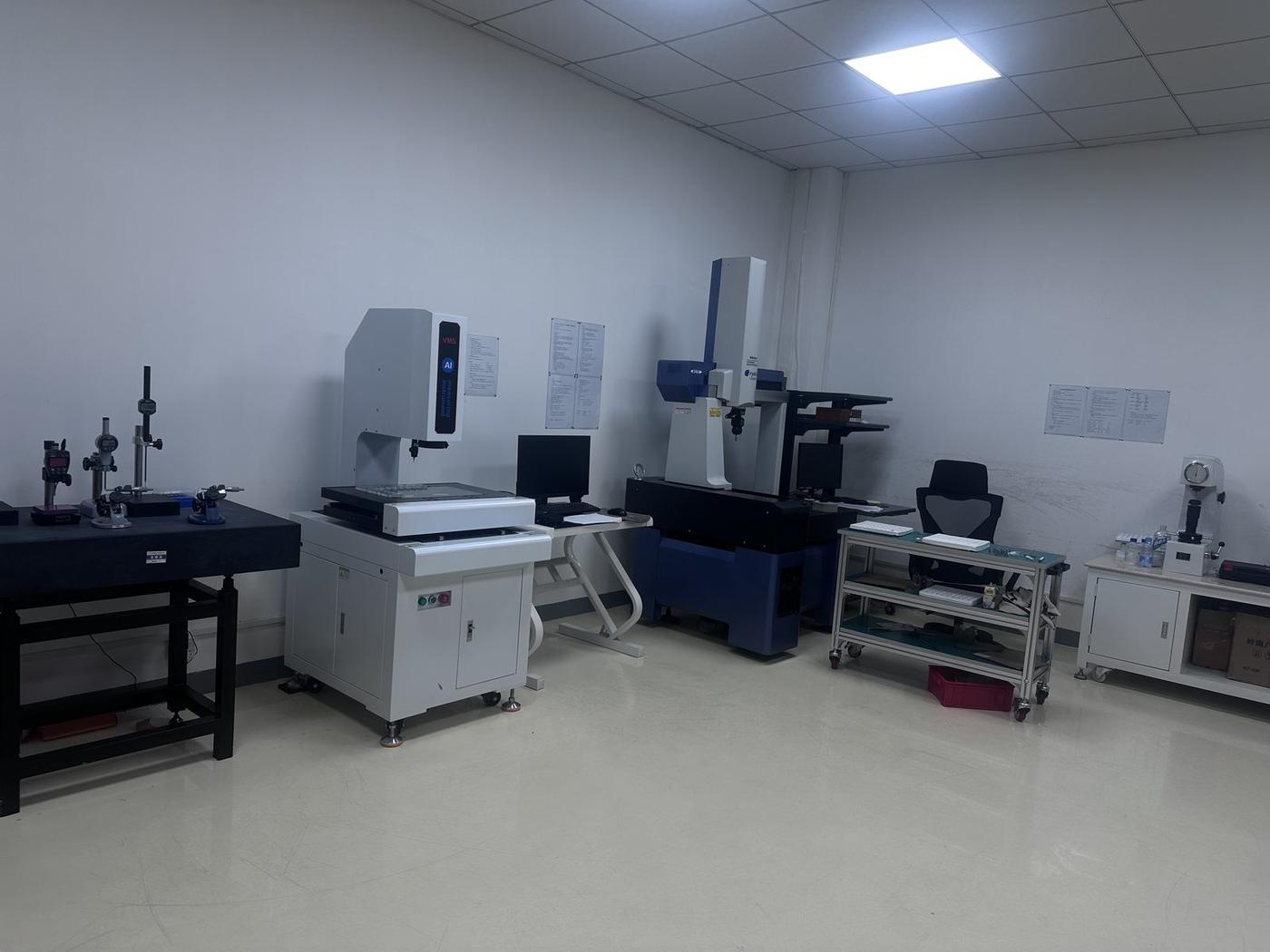
4.1 Minimum order: what one piece really carries
Starting from a single piece is not a slogan. It means programming, fixturing and first-article inspection all land on that one part — which is why material is often barely a tenth of a one-off price. It also explains why a prototype quote looks expensive: you are paying, in one invoice, for the process validation that the later batch relies on.
4.2 Lead time: where it actually queues
Lead time is rarely lost at the spindle. It queues at three places: arrival of special-grade material (3–7 days), the finishing tank schedule (3–5 days in peak season) and the CMM queue (1–2 days). When a date matters, ask about those three slots rather than asking "how fast can you go".
5. Five typical scenarios
Put these five scenarios through a prototype-and-small-batch schedule and a common thread appears: every one of them can be drawn, but only assembly reveals whether it works. That is the point of prototyping before scaling.
| Scenario | Typical parts | Why prototype before scaling |
|---|---|---|
| New product structure | Housings, brackets, panels | Fit and appearance cannot be judged on a drawing |
| Consumer electronics with frequent changes | Earphone shells, decorative parts | Tooling not cut yet — CNC validates feel, colour and acoustic cavity |
| Robot joints and transmissions | Joint housings, PEEK gears | Tolerance chains and weight only show up once assembled |
| Medical and automation equipment | Small stainless and titanium parts | High unit value; failure costs far more than the prototype |
| Liquid cooling and optical communication | Cold plates, TO headers, ferrules | Airtightness and concentricity must be measured, not assumed |
6. The process: six steps, each with a deliverable
| Step | What you provide | What you receive | Timing |
|---|---|---|---|
| 1 Brief | STEP + PDF, material grade, quantity, target date | DFM notes, including tolerances we suggest relaxing | Within 24 hours |
| 2 Process review | Critical tolerances and cosmetic standard | Itemised quote: material / hours / fixturing / finishing / inspection | Within 24 hours |
| 3 Prototype and first article | First-article acceptance points | Physical parts + full-dimension FAI report | 3–7 days |
| 4 Pilot batch | 30% of the order quantity | Pilot report and batch data | 5–10 days |
| 5 Production delivery | Packing and labelling requirements | Sampling records + shipping report | 7–15 days |
| 6 Review and optimise | The issue list from the previous batch | Cost-down proposals: tooling, material, tolerance | Quarterly |
7. Seven questions to ask before you order
1. Is the prototype made on the same process route as the batch? Changing the machine or the workholding invalidates the first-article verification.
2. How is finishing charged? Per tank, per piece, or a minimum charge — the three conventions can differ by 15%.
3. Which dimensions are in the first article report, and on what equipment? A report that only says "conforms" is not a report.
4. Can you share yield data from the last batch? If there is no batch data, there is probably no process control — only sorting at the end.
5. Is the simple fixture priced into the unit rate or listed separately? Separately is more transparent, and it tells you whether the spend is justified.
6. When does the lead time start? On receipt of drawings, on first-article approval, or on material arrival — a week of difference between the three.
7. Who carries rework and freight if something goes wrong? Put it in the contract; it beats negotiating afterwards.
Goldencube has been machining precision parts in Shenzhen for over a decade, and more than eight in ten CNC prototyping and small-batch orders we take start with a prototype. Not because we want to bill a prototype twice, but because those few dozen measured values expose assembly problems earlier than any verbal promise. Machine and process limits are on Capabilities, 5-Axis CNC Machining and Mill-Turn Machining; part families are on Products.
8. Common questions
Can the prototype fee be waived?
Ask first where the waived money went. The transparent arrangement is a prototype fee credited against the first production order above a certain quantity. A flat "free prototype" is usually priced into the unit rate or paid for by relaxing first-article inspection. For a buyer, a first article report with measured values is worth more than the few hundred saved.
How large a gap between 1 pc and 50 pcs is normal?
For simple parts, 2.5 to 4 times. For complex contoured parts it can be as little as 1.8 to 2 times, because programming dominates and does not amortise. If the gap is well under two times, either the single piece was overpriced or the fifty-piece quote uses a different process route — ask which.
What lead time should a 10–50 piece order expect?
Seven to fifteen days for standard materials and geometry, of which three to five days is programming and first article. Delays usually come from finishing slots and material arrival rather than machining, so confirm both when you order.
The first article passed — why does production drift?
Four usual causes: a different machine or workholding, tools worn without offset compensation, hardness variation between material lots, and fixtures that do not repeat. Pin the machine number and fixture ID into the first article report, and ask for batch sampling data instead of relying on the first-off part.
Is 20 pieces worth tooling up for?
Generally no. Die-casting and injection moulds only pay back in the thousands; at twenty pieces, CNC machining has a higher unit price but no tooling cost, no modification risk, and the design can still change. Revisit tooling once the design is frozen and annual volume is stable.
Send the drawing — start with an itemised quote
From one piece, itemised within 24 hours, with prototype and batch on the same process route and the same machines. Even if you end up choosing another supplier, the quote works as a benchmark.
Request a Quotation
Share your requirements — formal quotation within 24 hours. Your information is used for quoting only and kept strictly confidential.
Have drawings? Get an itemized quote within 24 hours
A 2D drawing + 3D model (STEP / IGES) + quantity tiers are enough. Material, machine hours, programming & fixtures, outsourcing and inspection listed separately, plus a free DFM sheet. No drawing review calls.
Send drawings for a quote