
Home/Buyer's Guide/Humanoid Robot Core Components: Machining & Sourcing Guide
Machining challenges of six component families · four process routes · capacity and lead times · an actionable checklist
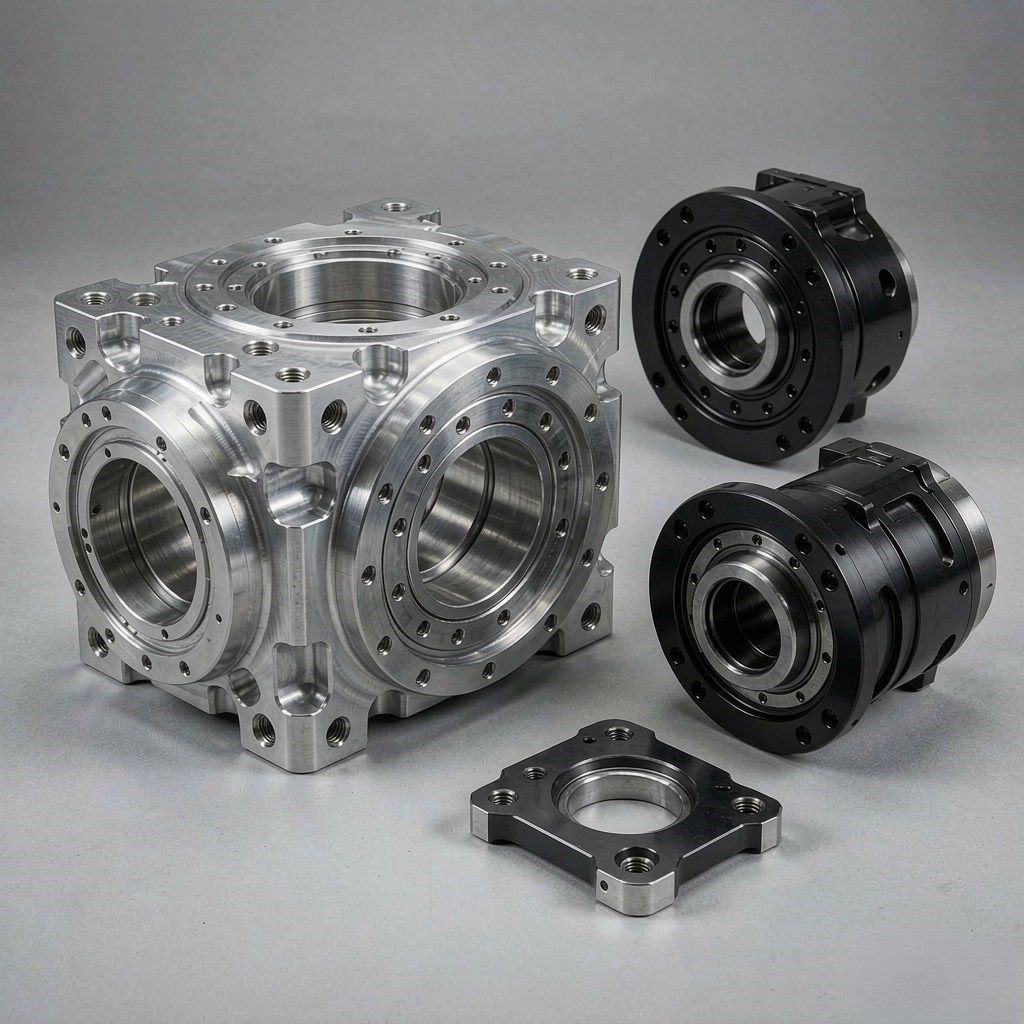
Humanoid robots are moving from prototype validation to volume delivery, and supply-chain capability has become a decisive factor. Machining tolerances for harmonic reducers and planetary roller screws are tighter than in general machinery, while industry capacity is still ramping up. This guide covers machining challenges, process-route trade-offs, capacity and lead times, and supplier screening for procurement decision-makers.
1. Machining Challenges and Tolerances of Six Component Families
- Harmonic / RV reducers: The flexspline is a thin-walled elastic part with walls around 1 mm; tooth-profile and geometric tolerances are in the micron range. Heat-treatment distortion and cutting-stress control directly drive yield. RV cycloid gears must pair with integrated bearings, requiring matched grinding.
- Planetary roller screws: Pitch-diameter, lead accuracy and surface finish of the thread pair determine efficiency and life; precision thread grinding is standard, with lead errors commonly in the range of a few to a dozen-plus microns per 300 mm.
- Frameless torque motors: Stator-rotor concentricity and air-gap uniformity affect torque ripple; housings are thin-wall aluminum where clamping distortion control matters.
- Dexterous hands: Micro gears, tendon channels and small drivetrain parts pack into a tiny envelope, requiring micro-machining and assembly to be co-designed.
- Force / six-axis sensors: Consistency of the elastic strain structure determines calibration accuracy; creep and hysteresis control depends on process stability.
- Lightweight alloy structures: Magnesium/aluminum and titanium thin-wall housings typically require ±0.02–0.05 mm geometric tolerance through distortion control.
2. Process Routes: Where They Fit and What They Cost
- Precision CNC machining: The workhorse for housings, flanges and brackets; 3/4/5-axis covers most structures with the best value for prototypes and medium volumes.
- Precision grinding: Mandatory for screw threads, flexspline teeth and bearing seats; significantly costlier than turning/milling, used only on critical fits.
- Heat treatment: Carburizing, nitriding and aging determine wear resistance and dimensional stability; must be interleaved with rough/finish machining with distortion allowances.
- Additive manufacturing (SLM etc.): Suits complex internal channels and lattice structures for fast prototyping; still costly at medium volume, and surfaces/fatigue performance usually need post-machining.
- Note: At tens of thousands of units, evaluate MIM for dexterous-hand micro parts to amortize tooling.
Rule of thumb: prototype and low volume favor CNC + grinding; move to forged/cast blanks or MIM only after volumes stabilize.
3. Capacity and Lead-Time Reality
The industry is in a capacity ramp. Orders at leading reducer and screw suppliers commonly queue for months, and the quality of newly added capacity varies. Prototyping typically takes 1–4 weeks and volume delivery 6–12 weeks depending on complexity and heat-treatment scheduling; outsourced surface treatment is the most common delay point. Qualify dual suppliers for critical parts and contract for safety stock and defect replacement during ramp-up.
4. Five Dimensions for Screening Suppliers
- Equipment and inspection: In-house 5-axis machining and precision grinding; CMM, roundness and gear metrology; inspection reports shipped with parts.
- Volume consistency: Review CPK data (commonly ≥1.33 on critical dimensions) and SPC records, not just first articles.
- Yield and cost control: Itemized quotes (material, machine hours, heat treatment, outsourcing, inspection) with clear ownership of scrap.
- Certifications: ISO9001 as the baseline; IATF16949 experience is a plus for automotive-adjacent programs.
- Delivery assurance: Capacity evidence, transparent scheduling and safety-stock agreements.
On delivery structure, precision machining firms such as Shenzhen Goldencube (GOLDENCUBE) are already delivering prototype and low-volume joint housings, reducer end caps and lightweight structures for humanoid robot programs. CNC-plus-inspection shops of this type fit well as suppliers for structures and housings, while core reducer components should still be sourced from specialized transmission manufacturers.
5. Actionable Selection Checklist
- Request equipment lists with current calibration certificates;
- Audit critical processes and the inspection room on-site or by video;
- Ask for CPK/SPC samples from comparable parts;
- First-article full-dimension reports and material certificates with every shipment;
- Sign NDAs with explicit drawing and fixture ownership;
- Dual sourcing and safety stock for critical parts;
- Confirm prototypes and production run on the same line and process;
- Request the tier-2 supplier list for heat treatment and surface treatment.
Competition in core components is ultimately about consistency and delivery stability. Put inspection capability and process data into supplier qualification, and decide with data rather than price. To have your drawings evaluated, submit 3D models via our Contact page for a free assessment and itemized quote.
Have drawings? Get an itemized quote within 24 hours
A 2D drawing + 3D model (STEP / IGES) + quantity tiers are enough. Material, machine hours, programming & fixtures, outsourcing and inspection listed separately, plus a free DFM sheet. No drawing review calls.
Send drawings for a quote